


[Research Report] Energy Conservation and Greenhouse Gas Emissions Reduction in Healthcare Facilities: Case Studies from New Construction and Facility Renewal (March 16, 2026)
date : 3/16/2026
Tags: Planetary Health

![[Research Report] Energy Conservation and Greenhouse Gas Emissions Reduction in Healthcare Facilities: Case Studies from New Construction and Facility Renewal (March 16, 2026)](https://hgpi.org/en/wp-content/uploads/sites/2/HGPI_20260316_GHG-Reduction-Case-Studies.jpg)
The Planetary Health Project of Health and Global Policy Institute’s (HGPI) has published a report titled “Energy Conservation and Greenhouse Gas Emissions in Healthcare Facilities: Case Studies from New Construction and Facility Renewal”. The report draws on practical knowledge from three medical institutions, providing a replicable framework for medical organizations undertaking facility renewal, with the goal of simultaneously reducing greenhouse gas (GHG) emissions, improving operational management, and strengthening disaster response capabilities. Please refer to the PDF below for full details.
Since its establishment, the project has explored the relationship between the global environment and human health through the concept of planetary health, which connects environmental sustainability with human well-being. Centered on the global issue of environment and health, the project has discussed the policy directions Japan should pursue through policy recommendations and advisory board meetings.
To date, activities have addressed both adaptation measures, which prepare healthcare systems for the impacts of climate change, and mitigation measures, which reduce the environmental burden caused by healthcare systems themselves as sources of emissions. In 2024, the project convened a planetary health expert meeting to share international knowledge and discuss areas in which Japan’s healthcare system can reduce its environmental footprint and collaborate with the international community. Through discussions with leading experts from Japan and abroad, the meeting presented a vision for a sustainable and resilient health system.
Building on these activities, this case studies report shifts the focus toward practical knowledge for implementation. Despite facing the “triple constraints” of weakened financial position, sharp rises in construction costs, and capital investment limitations, three pioneering hospitals succeeded in reducing GHG emissions through innovative approaches to facility infrastructure. Drawing on interviews and analysis conducted by the project, their experiences have been organized into shared practical insights. The report demonstrates that strategic decision-making and on-the-ground ingenuity can create breakthroughs, and it presents the concrete processes through which this was achieved.
Key Points from the “Case Studies of GHG Reduction Initiatives in Healthcare Institutions”
This collection of case studies analyzes three hospitals that differ in governance structure but share a common role as regional core hospitals with approximately 400 beds. It examines how they overcame the triple constraints faced during facility renewal and achieved environmental sustainability, management improvement, and disaster resilience simultaneously, summarizing the process into six key recommendations.■ Strategy: Mobilizing Resources to Address Operational Challenges
Recommendation 1: Position environmental impact reduction as strategic investments
Rather than framing efforts as purely environmental, they should be redefined as solutions to management challenges such as rising costs and vulnerabilities in the Business Continuity Plan (BCP).
Recommendation 2: Collaboration with external partners
Engaging expertise from architectural firms and specialized companies and creating a system where these stakeholders can actively participate in discussions is essential for successful implementation.
Recommendation 3: Strategic framework for utilizing subsidies
Subsidies should be used not merely as a means to fill financial gaps but as leverage to strengthen project frameworks and improve the quality of design.■ Design: Integrating Architectural Approaches with On-site Knowledge
Recommendation 4: Prioritize demand reduction through passive design
Compact building layouts and improved insulation reduce both initial investment costs and long-term operational costs.
Recommendation 5: Extensive interviews with all departments
By grasping a true understanding of actual workflows across departments, hospitals can eliminate unnecessary equipment and achieve designs that staff can realistically operate.■ Operation: Institutionalizing Continuous Improvement
Recommendation 6: Establish operational PDCA cycles
Using data from systems such as Building Energy Management System (BEMS) enables ongoing optimization through collaboration between frontline staff and management even after construction is completed.
This case studies report demonstrates that even under severe financial conditions faced by healthcare institutions, facility renewal can be strategically used as a turning point to simultaneously achieve environmental goals (GHG reduction), management improvement, and strengthened disaster preparedness and business continuity. A common feature among the three hospitals studied was that they redefined environmental initiatives as investment strategies to solve management challenges and pursued them through a consistent vision from the design stage to the operational stage.
The six recommendations presented in this report go beyond individual case descriptions and are intended to be utilized as practical implementation guidelines that other healthcare institutions can adapt according to their own circumstances.
HGPI will continue to advance policy recommendations and implementation support from the perspective of planetary health, aiming to both reduce environmental impacts in the health sector and strengthen resilience, thereby contributing to the development of sustainable and robust healthcare systems.
![[Research Report] Energy Conservation and Greenhouse Gas Emissions Reduction in Healthcare Facilities: Case Studies from New Construction and Facility Renewal](/assets/img/katsudo/icon_pdf_l.png)
Related Posts
-
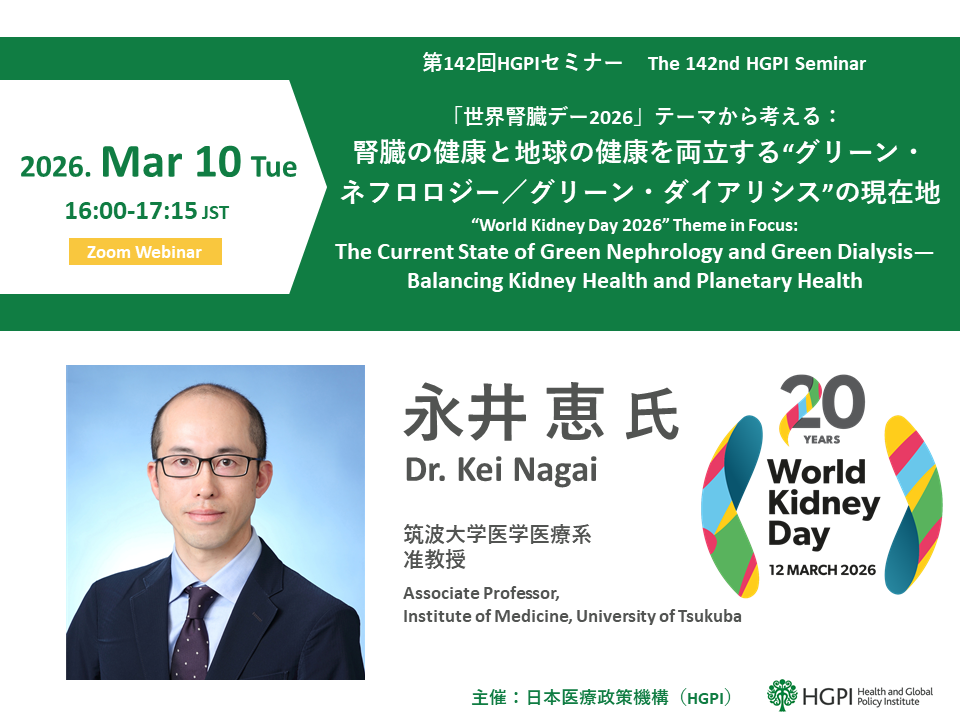
2026-03-11
[Event Report] The 142nd HGPI Seminar “World Kidney Day 2026” Theme in Focus: The Current State of Green Nephrology and Green Dialysis—Balancing Kidney Health and Planetary Health (March 10, 2026)
-
2025-11-13
[Research Report] Perceptions, Knowledge, Actions and Perspectives of Healthcare Organizations in Japan in Relation to Climate Change and Health: A Cross-Sectional Study (November 13, 2025)
-
2025-11-11
[Event Report] From Vision to Action: Greening Japan’s Healthcare “Online Seminar: Climate and Health 101” (September 13, 2025)
-
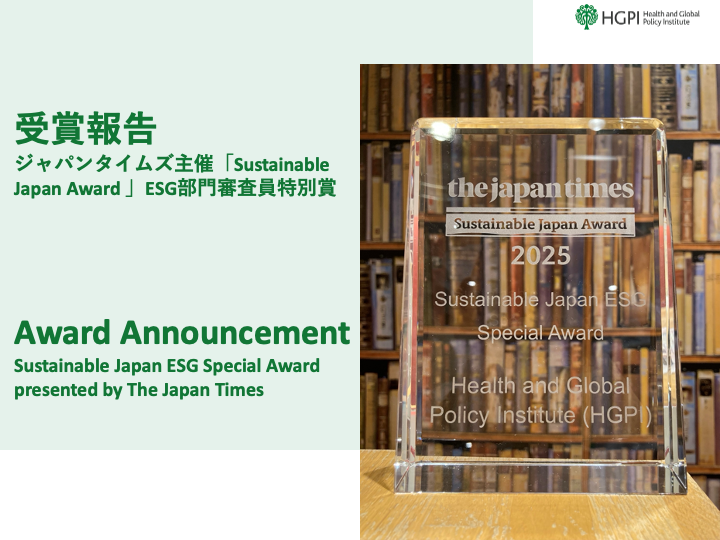
2025-10-15
[Award Report] Sustainable Japan Award 2025 (ESG Category) (The Japan Times, September 18, 2025)
Top Research & Recommendations Posts
- [Research Report] Perceptions, Knowledge, Actions and Perspectives of Healthcare Organizations in Japan in Relation to Climate Change and Health: A Cross-Sectional Study (November 13, 2025)
- [Policy Recommendations] Reshaping Japan’s Immunization Policy for Life Course Coverage and Vaccine Equity: Challenges and Prospects for an Era of Prevention and Health Promotion (April 25, 2025)
- [Research Report] The 2025 Public Opinion Survey on Healthcare in Japan (March 17, 2025)
- [Research Report] Building a Mental Health Program for Children and Measuring its Effectiveness (June 16, 2022)
- [Research Report] The 2026 Public Opinion Survey on Healthcare in Japan (February 13, 2026)
- [Research Report] 2019 Survey on Healthcare in Japan
- [Policy Recommendations] Developing a National Health and Climate Strategy for Japan (June 26, 2024)
- [Policy Recommendations] Mental Health Project: Recommendations on Three Issues in the Area of Mental Health (July 4, 2025)
- [Research Report] The 2023 Public Opinion Survey on Satisfaction in Healthcare in Japan and Healthcare Applications of Generative AI (January 11, 2024)
- [Research Report] The Public Opinion Survey on Child-Rearing in Modern Japan (Final Report) (March 4, 2022)
Featured Posts
-
2026-03-03
[Registration Open] Online Seminar “Implementing Chronic Kidney Disease (CKD) Measures into Society: Towards a Data-Driven Health System” (April 21, 2026)
![[Registration Open] Online Seminar “Implementing Chronic Kidney Disease (CKD) Measures into Society: Towards a Data-Driven Health System” (April 21, 2026)](https://hgpi.org/en/wp-content/uploads/sites/2/HGPI_20260421_CKDonlineseminar-.png)
-
2026-03-16
[Research Report] Energy Conservation and Greenhouse Gas Emissions Reduction in Healthcare Facilities: Case Studies from New Construction and Facility Renewal (March 16, 2026)
